Design and Process FMEA
What it does
Generates a complete Design FMEA — failure modes, effects, causes, controls, RPN, recommended actions — for any artifact in the hierarchy.
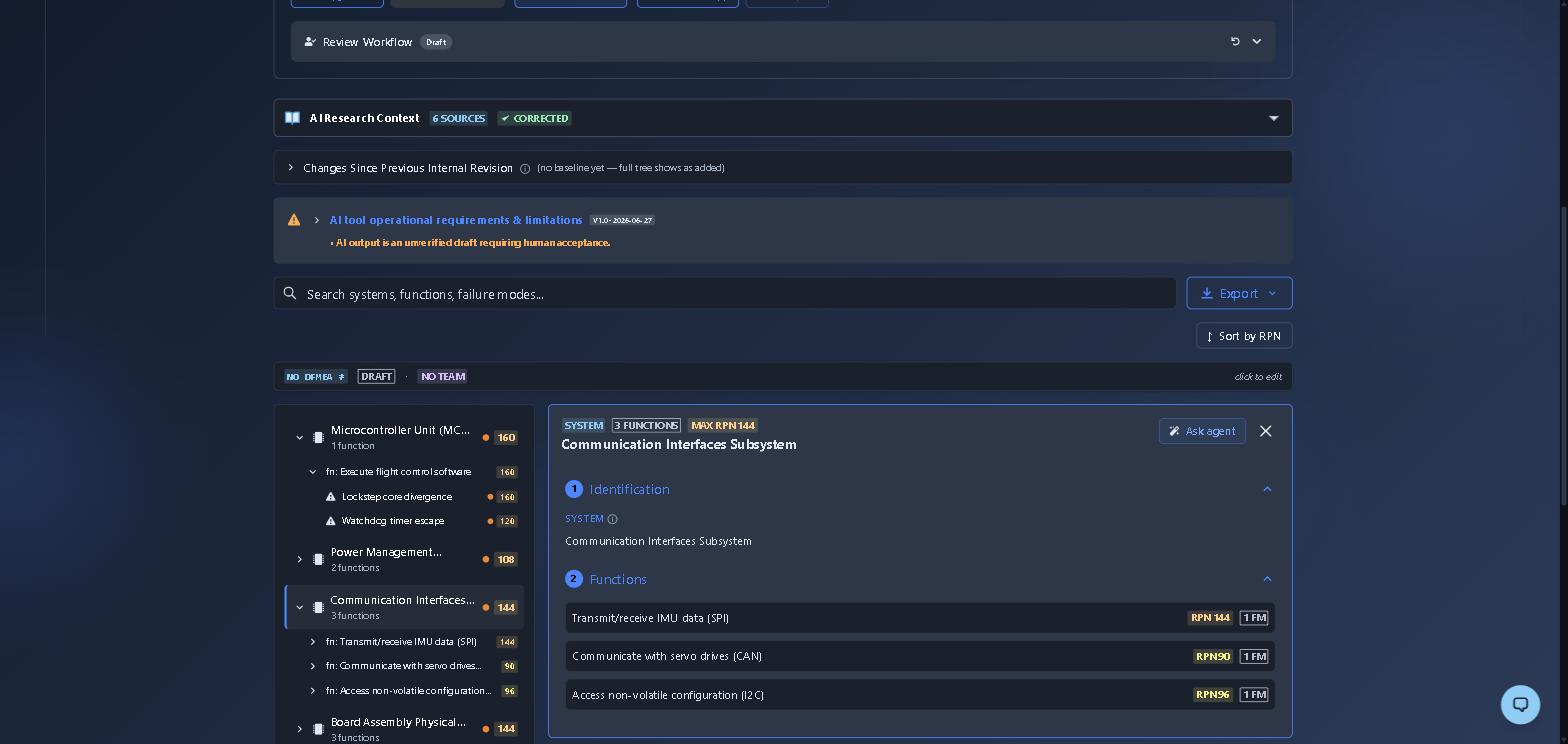
The tree carries RPN at every level, so the worst branch is visible without opening anything — here the Communication Interfaces subsystem at max RPN 144. Note the banner: AI output is labelled an unverified draft requiring human acceptance, and the analysis is retained as a controlled record.
Why it matters
A traditional DFMEA workshop runs 2–3 days with 4–6 engineers. Creopus drafts the same artifact in under 5 minutes, then engineers spend an hour refining instead of three days creating.
How it works
- Open a subsystem or assembly in the hierarchy.
- Trigger DFMEA from the actions menu.
- AI reads linked artifacts (requirements, block diagram, BOM) and proposes failure modes per component/function.
- Each row includes: failure mode, effect, severity, cause, occurrence, current controls, detection, RPN, recommended actions.
- Submit for review. Reviewers can request specific failure modes be reconsidered or expanded.
Key capabilities
- Cross-artifact awareness — uses requirements + BOM + block diagram as input.
- RPN auto-calculation with ISO 9001 / IATF 16949 mapping.
- Severity-based filtering for review priority.
- Implement on review — accept a reviewer comment and AI patches the FMEA row.
Process FMEA
PFMEA is a separate tool alongside DFMEA, for failure modes in the manufacturing and assembly process rather than the design. Same structure, same review workflow, same hierarchy linking — but scoped to process steps rather than components and functions.
Use DFMEA for "what can go wrong with this design", PFMEA for "what can go wrong when we build it".
Where findings go next
An FMEA is only worth the actions that come out of it, so the failure modes do not stay trapped in the document:
- Risk Register — high-RPN failure modes can be pulled into the Risk Register as programme-level risks, so a design finding reaches the people tracking programme risk.
- CAPA — a failure mode that has actually occurred can be escalated into a Corrective and Preventive Action record with its own status workflow, linked back to its source.
This is the difference between an FMEA that gets filed and one that gets acted on.