Two ways to author — AI generation and hand-authoring, one change-controlled loop
What it does
Every engineering tool on Creopus (requirements, DFMEA, DVP, block diagram, BOM, ConOps, ICD, risk register, and the rest) opens with the same choice:
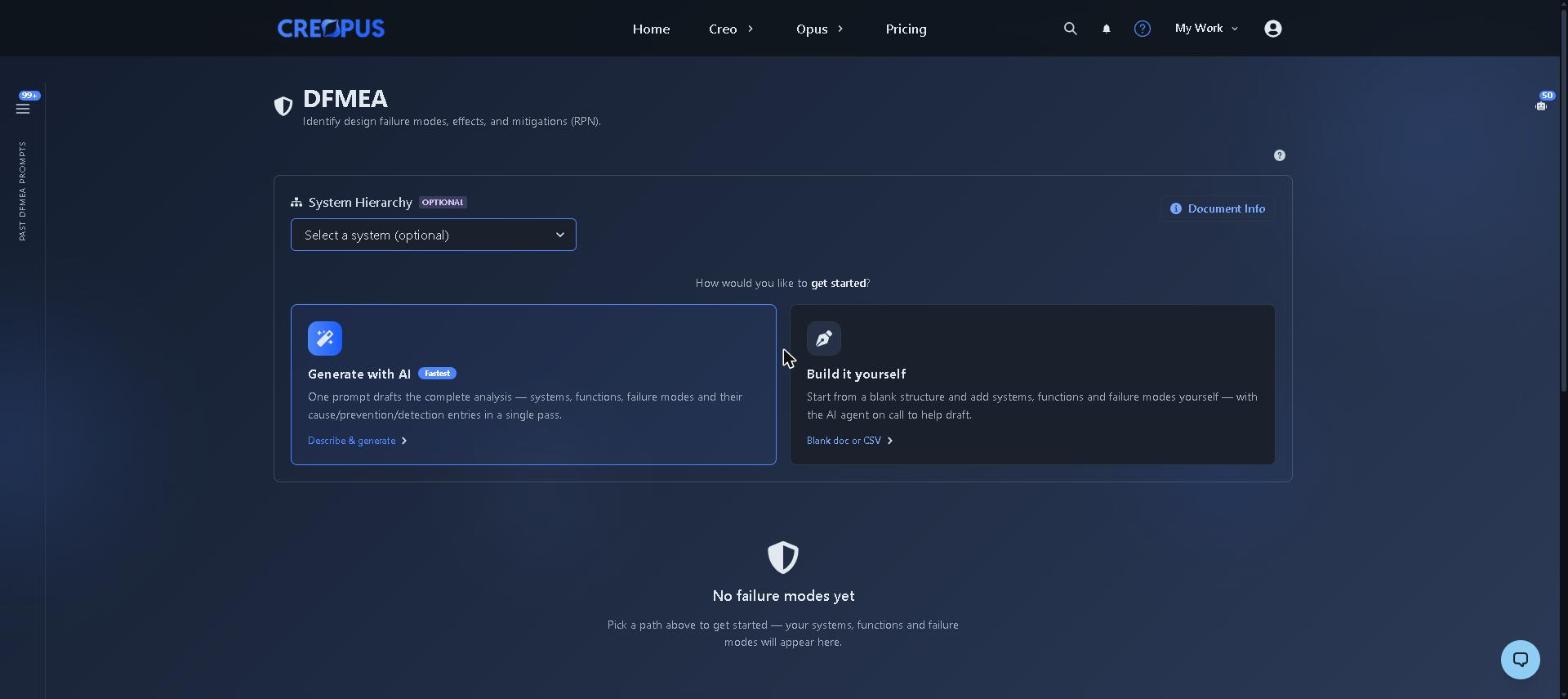
- Generate with AI — one prompt drafts the complete document in 30–90 seconds, grounded in your hierarchy node and any documents you attach.
- Build it yourself — start a blank document (or import a CSV, including the tool's own exported worksheets) and author it by hand, with the AI agent on call for any slice you'd rather delegate.
Both paths produce the same kind of document, with the same revisions, reviews, baselines, and traceability — the platform never treats hand-authored work as second-class.
Why it matters
Real engineering documents are rarely purely AI-drafted or purely hand-written. A DFMEA might start from an AI draft and get hand-tuned; a requirements set might be imported from a spreadsheet and then extended with AI follow-ons. Creopus makes the provenance explicit — AI-generated content carries an honest AI-limitations notice, hand-authored content doesn't — and gives both the same controlled change loop.
How the change loop works
- Fresh documents are directly editable. A hand-authored (manual or imported) document that has never been baselined can be edited in place — add, edit, and delete items with the tool's own affordances.
- AI changes always land as follow-ons. Whether you type a follow-on prompt yourself (turn on Follow-on Mode — the prompt composer appears only then) or ask the agent, the change arrives as a working copy with a colored diff against the main document. You review it, then merge.
- Baselining locks the main document. Once a document has been baselined (a review approved it, or you froze a revision), direct edits are blocked platform-wide — for humans and the AI agent. The sanctioned route is: start a working copy, change it, review the diff, merge. Every merge is a tracked revision.
- CSV round-trips. Tools with tabular shapes (requirements, ICD, BOM, DFMEA, Pugh, risk register, and more) import CSV — including their own exports, so you can edit in a spreadsheet and bring it back losslessly. Derived numbers (like DFMEA RPN) are recomputed on import, never trusted from the file.
The agent as a co-author
- Draft with the agent — an empty hand-authored document offers a one-click handoff: the agent is pre-briefed on the document, its hierarchy node, and your attachments, interviews you for what's missing, proposes content in chat, and lands the agreed set as a single follow-on.
- Ask agent buttons sit beside sections and items — each seeds the agent with that slice's specifics ("add three thermal failure modes to this function") so you never re-explain the document.
- The agent's contract is the same as yours: propose in chat → land as a follow-on → you review and merge. No silent edits, ever.
Limits
- Blank documents and CSV imports are unmetered (they don't consume AI generation quota); AI generation and agent usage meter per your plan.
- A few tools are deliberately different: the Checklist instantiates from published template packs, and the Procurement / Implementation Workspaces are container tools you fill by searching or uploading — they have no AI-vs-manual chooser because there is nothing to generate.